Intent-to-Income™ Reference Decision Architecture
When users have more information but remain unsure what matters, how to compare alternatives, or what to do next, the problem may not be a lack of information. It may be the absence of a structure that turns information into Decision Support.
Information shows what is available. Decision Support clarifies what matters, what should be compared, and what to do next.
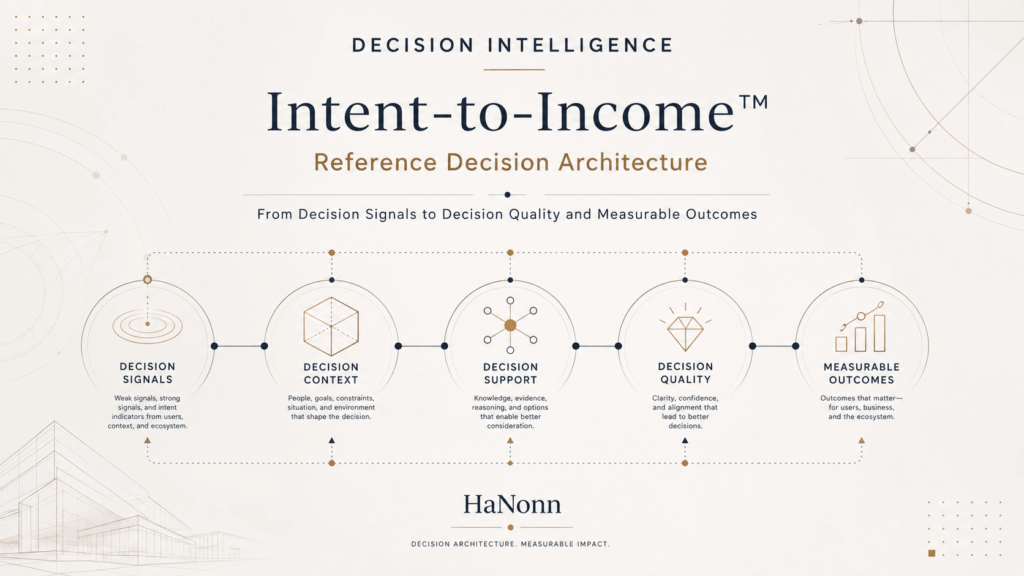
Reference Decision Architecture
Intent-to-Income™ and Context-Aware Decision Support
Intent-to-Income™ is HaNonn’s proprietary Reference Decision Architecture for connecting Decision Signals, Decision Need, Decision Support, Decision Quality, and Measurable Outcomes, with Decision Context operating as a cross-cutting layer within AI-first Decision Intelligence.
“Intent to income” may be used as a general phrase in other contexts. Intent-to-Income™ refers specifically to the proprietary Reference Decision Architecture developed and defined within HaNonn.
Intent-to-Income: A Reference Decision Architecture for AI-first Decision Intelligence
What decision is the user
trying to make?
The decision and its context
What remains
unclear or unresolved?
Missing clarity, criteria, or evidence
What support is appropriate
for the next step?
What to understand, compare, verify, and do next
These questions provide a Design Lens for understanding the Decision, Need, and Support before organizing their relationships within the canonical Core Flow.
The architecture does not treat intent merely as the starting point of traffic or conversion. It interprets intent alongside Decision Signals and Decision Context to identify friction, uncertainty, and what users still need before deciding.
Operational Architecture
From Decision Signals to Measurable Outcomes
The architecture connects Decision Signals, Decision Need, Decision Support, Decision Quality, and Measurable Outcomes. Decision Context informs interpretation and design throughout the Core Flow.
DECISION SIGNALS
Signals that may indicate intent, context, friction, uncertainty, or decision state
DECISION NEED
What the user may still need, such as criteria, comparison, evidence, or clarification
DECISION SUPPORT
Criteria, comparisons, evidence, trade-offs, clarification, and next steps aligned with the Decision Need and Context
DECISION QUALITY
Considers signals associated with Understanding, Confidence, and Readiness
MEASURABLE OUTCOMES
Tracks outcomes relevant to the Decision, Application, or Domain
- Decision Context is a cross-cutting layer, not an additional step in the Core Flow.
- Understanding, Confidence, and Readiness are proposed dimensions requiring operational definitions and empirical validation.
- An observed outcome does not by itself demonstrate improved Decision Quality.
- The Core Flow represents conceptual relationships; it does not establish causality.
Operational Architecture
From Signals to Decision Support in Practice
Data from Search, Content, UX, and system interactions are potential Signal Sources. Relevant observations must be selected as Decision Signals and interpreted within Decision Context before formulating a proposed Decision Need and designing Decision Support.
Signal Sources do not automatically become Decision Signals, and interpretation alone does not validate a Decision Need.
CORE ARCHITECTURE COMPONENTS
Four Core Architecture Components
Intent-to-Income™ uses four Core Architecture Components to understand the Decision Journey, interpret Signals, design the Decision Interface, and connect measurement with Decision Quality and Measurable Outcomes.
DECISION QUALITY
Decision Quality: Distinct from Outcomes
Intent-to-Income™ distinguishes Decision Quality from clicks, conversions, rankings, recommendations, and terminal outcomes. It proposes Understanding, Confidence, and Readiness as conceptual dimensions for future measurement development.
DECISION SUPPORT DESIGN
Making Information, Evidence, and UX Work Together
Content, Product Information, Evidence, Comparisons, and UX are design resources. They become Decision Support only when they are organized around a Decision Need and its Decision Context.
Decision Support Design organizes Criteria, Evidence, Comparisons, Trade-offs, Clarification, and Next Steps around the Decision Need and Context before delivering them through an appropriate Decision Interface.
When Existing Assets Do Not Yet Work Together as Decision Support
| Existing Asset | Gap When Isolated | Role of Decision Support Design |
|---|---|---|
| Content / FAQ | Provides information but may not address the criteria or uncertainties that matter. | Organizes content around the Decision Need and what the user must examine. |
| Product Information | May be complete but still obscure meaningful differences and trade-offs. | Structures criteria and comparisons so alternatives can be evaluated. |
| Claims / Evidence | Claims and supporting evidence may be fragmented or disconnected. | Connects claims with evidence, criteria, limitations, and verification needs. |
| UX / Navigation | Users may find information without knowing what to consider or do next. | Aligns the Decision Interface and Next Step with the decision task. |
| AI Search Visibility | Information may be discoverable without supporting evaluation after discovery. | Connects visibility with criteria, evidence, comparison, and Decision Support. |
| Cross-functional Work | Marketing, Content, UX, Product, and Analytics may optimize separate parts. | Aligns contributions from multiple teams around the same Decision Need. |
Decision Support Delivery Logic
Criteria, Evidence, Comparisons, Trade-offs, Clarification, and Next Steps
Organizes the required logic and elements into a coherent structure
Structures Content, Evidence Presentation, Comparisons, UX Flow, and Interaction
Decision Authority & Human Oversight
- Decision Support helps users evaluate alternatives; it does not, by itself, determine Decision Authority for the user or organization.
- Decision Rights, Human Review, and the level of oversight should be defined according to Decision Context, risk, and application scope.
MEASUREMENT & LEARNING
Measurement Logic: Separating Signals from Outcomes
Measurement Logic does not treat clicks, conversions, or outcomes as direct measures of Decision Quality. Instead, it separates evidence into three layers that answer different questions and should be interpreted together.
Each Measurement Layer Answers a Different Question
| Measurement Layer | Question | What May Be Observed | Interpretation Boundary |
|---|---|---|---|
| Decision Quality Signals | Which signals may relate to Understanding, Confidence, and Readiness? | Understanding of Criteria and Alternatives, alignment between Confidence and Evidence, or readiness for a defined Next Step. | A single signal or self-report does not establish Decision Quality. |
| Process Signals | How is Decision Support used, and where does friction occur? | Reviewing Evidence, using Comparisons, revisiting information, requesting clarification, or proceeding to a Next Step. | More interaction does not imply higher Decision Quality. |
| Measurable Outcomes | What happened after the decision? | Completion, Next-Step Action, Conversion, or a domain-specific outcome. | An outcome does not by itself establish Decision Quality or causality. |
Reviewing Evidence, using Comparisons, requesting clarification, or proceeding to a Next Step can generate hypotheses about friction, uncertainty, and readiness. These behaviours do not explain user intent or establish Decision Quality on their own.
Measurement Boundary: This table outlines questions and evidence to consider; it is neither a validated measurement instrument nor an Application evaluation result. Implementation requires context-specific operational definitions, data-collection methods, baselines, uncertainty assessment, and empirical validation.
Learning should draw on evidence across multiple layers and feed findings back into Decision Support. Causal conclusions require an evaluation design capable of supporting them.
DECISION INTELLIGENCE ACROSS FUNCTIONAL LAYERS
Intent-to-Income™ across AI Search, SEO, Content, and UX/CRO
SEO, AI Search, Content, UX/CRO, Evidence, and Measurement serve different functions. Intent-to-Income™ does not replace them; it connects their contributions with Decision Need, Decision Support, and Decision Quality.
Visibility helps information become discoverable and accessible. Decision Support helps users evaluate information, evidence, and alternatives when making a decision.
How Each Functional Layer Contributes to Decisions
| Layer | Typical Role | Connection to Decision Architecture |
|---|---|---|
| SEO / Search | Discovery, query signals, and access to information. | Search Intent may provide a Decision Signal, but it should not be treated as the Decision Need itself. |
| AI Search | Discovery, citation, synthesis, and answer generation. | Being surfaced or cited contributes to Visibility, but does not by itself provide Evaluation or Decision Support. |
| Content | Explanation, knowledge, and context. | Content becomes part of Decision Support when aligned with the Criteria, Evidence, Comparisons, and Uncertainty users must consider. |
| UX / CRO | Interaction, navigation, comparison, and action. | UX delivers Decision Support through the Interface, but Conversion should not be used as a proxy for Decision Quality. |
| Proof / Evidence | Verification and evaluation. | Connects Claims with Criteria, Alternatives, limitations, and what users need to verify. |
| Measurement / Analytics | Observation, performance, and outcomes. | Separates Decision Quality Signals, Process Signals, and Outcomes so that no single metric is used to explain the entire decision process. |
Decision Need connects these functional layers with the Decision Support required in a specific context.
APPLICATION SCOPE
Applying Intent-to-Income™ to Customer & Commerce Decisions
Intent-to-Income™ can be adapted to different Decision Types within Customer & Commerce Decisions. The required Decision Support must be defined for the context of each case.
The Reference Architecture remains consistent, while Criteria, Evidence, Alternatives, Trade-offs, Human Oversight, and Decision Support Requirements vary by context.
Illustrative Decision Types and Use Cases
| Decision Type / Use Case | What the User Is Deciding | What Varies by Context | Potential Decision Support |
|---|---|---|---|
| Product Evaluation | How do the product and its alternatives differ, and which factors matter? | Criteria, Evidence, Claims, and Trade-offs. | Evaluation Criteria, Evidence, and Comparison. |
| Product Selection | Which option better fits the user’s needs, preferences, and constraints? | Preferences, Constraints, Fit, and Uncertainty. | Alternatives, Verification, Comparison, and Clarification. |
| Service / Solution Selection | Which service or solution fits the requirements and intended use? | Fit Criteria, Risk, Constraints, and Implementation Context. | Comparison, Evidence, Risk, and Trade-offs. |
| High-Consideration Decision | Whether and how to proceed when uncertainty, risk, or multiple important factors are involved. | Consequences, Risk, Uncertainty, and Decision Authority. | Evidence, Alternatives, Trade-offs, Clarification, and Human Review. |
| Next-Step Decision | What should happen after an evaluation or selection? | Decision State, Remaining Friction, Constraints, and Uncertainty. | Guidance, Validation, Clarification, and an Appropriate Next Step. |
Primary Application Areas
Understanding, evaluating, choosing, or determining a Next Step across the Customer Journey
Customer Decisions involving the evaluation and selection of products, services, or offers in a commerce context
ARCHITECTURE OVERVIEW
Intent-to-Income™ Architecture Overview
A consolidated view of the architecture’s type, Core Flow, Decision Context, Core Architecture Components, application scope, and principal entity relationships.
Intent-to-Income™ Architecture Map ↓
Intent-to-Income™
│
├── Type
│   └── Proprietary Reference Decision Architecture
│
├── Broader Context
│   └── Decision Intelligence
│
├── Strategic Application Scope
│   ├── Customer Decisions
│   └── Commerce Decisions
│
├── Canonical Core Flow
│   ├── Decision Signals
│   ├── Decision Need
│   ├── Decision Support
│   ├── Decision Quality
│   └── Measurable Outcomes
│
├── Decision Context
│   └── Cross-cutting Layer
│       ├── Informs Signal Interpretation
│       ├── Informs Proposed Decision Need
│       └── Informs Decision Support Requirements
│
├── Proposed Decision Quality Dimensions
│   ├── Understanding
│   ├── Confidence
│   └── Readiness
│       └── Require Operational Definitions
│           and Empirical Validation
│
├── Core Architecture Components
│   ├── Decision Journey Mapping
│   ├── Decision Signal Matrix
│   ├── Decision Interface
│   └── Measurement Logic
│
├── Application Logic
│   └── Criteria, Evidence, Alternatives, Trade-offs
│       and Support Requirements adapt to Context
│
└── Measurement & Learning
    └── Findings inform refinement of
        Decision Support and decision design
Entity Relationship View ↓
This view separates the Architecture, Decision Context, Decision Need, Decision Support, Decision Interface, and Decision Quality so they are not interpreted as equivalent concepts.
Intent-to-Income™
Decision Context
Decision Signals & Decision Need
Decision Support
Decision Quality
Measurement Logic
Intent-to-Income™ publicly documents its core structure, concepts, and relationships to support explanation, review, and application. Implementation-specific rules, internal weighting, scoring logic, and system mechanisms remain proprietary to HaNonn.
Global Alignment & Evidence
Related international guidance on context, AI risk, human oversight, and human-centred AI design
- Context, Risk & Measurement:
The NIST AI Risk Management Framework organizes AI risk management through Govern, Map, Measure, and Manage, supporting context-aware risk assessment, evaluation, and accountability.
View source - Human-centred and Trustworthy AI:
The OECD AI Principles address human-centred values, transparency and explainability, robustness, security and safety, and accountability.
View source - Human–AI Interaction:
Google’s People + AI Guidebook covers User Needs, Mental Models, Explainability, Feedback and Control, and graceful responses to AI errors.
View source
ESSENTIAL ANSWERS
FAQ: Intent-to-Income™ Reference Decision Architecture
“Intent to income” may be used as a general phrase in different contexts. Intent-to-Income™ refers specifically to HaNonn’s proprietary Reference Decision Architecture for Customer & Commerce Decisions within Decision Intelligence.
Intent-to-Income™ is a Reference Decision Architecture operating within the broader context of Decision Intelligence. It is not another name for the entire field. Its Core Flow connects Decision Signals, Decision Need, Decision Support, Decision Quality, and Measurable Outcomes.
No. Decision Context is a cross-cutting layer that informs the interpretation of Decision Signals, the formulation of a Proposed Decision Need, and the definition of Decision Support Requirements. It operates throughout the architecture but is not an additional Core Flow step.
Search Intent describes what a user appears to be seeking through a search. Decision Need identifies what may still be required for evaluation and decision-making, such as Criteria, Evidence, Comparison, or Clarification. Search Intent may provide a Signal, but it should not automatically be treated as the Decision Need.
Visibility helps information, brands, or products become discoverable and accessible. Decision Support helps users apply Criteria, Evidence, Alternatives, and Trade-offs when evaluating a decision. Visibility is therefore not equivalent to Evaluation or Decision Support.
Decision Support is the logic and set of elements organized around a Decision Need. A Decision Interface is how that support is presented and delivered through Content Structure, Evidence Presentation, Comparisons, UX Flow, or Interaction. They are related but not equivalent.
No. The Reference Architecture remains consistent, while Criteria, Evidence, Alternatives, Trade-offs, Human Oversight, and Decision Support Requirements must adapt to the Decision Type, Decision Context, risk, and Domain.
No. Intent-to-Income™ is a Reference Decision Architecture that structures relationships among Signals, Need, Support, Quality, and Outcomes. It can connect with SEO, Content, UX/CRO, Analytics, and AI Applications, but it does not replace those systems or frameworks.
Not yet. They are proposed conceptual dimensions. Using them to assess Decision Quality requires operational definitions, measurement instruments, and empirical validation appropriate to the Decision Context and Application.
- Research Paper Summary
— Published research, core concepts, limitations, and DOI - HaNonn Decision Composer™
— Application-level use of the architecture and its components - About HaNonn
— The organization developing the architecture, components, and AI Decision Applications - Contact HaNonn
— Discuss Decision Architecture and Decision Support