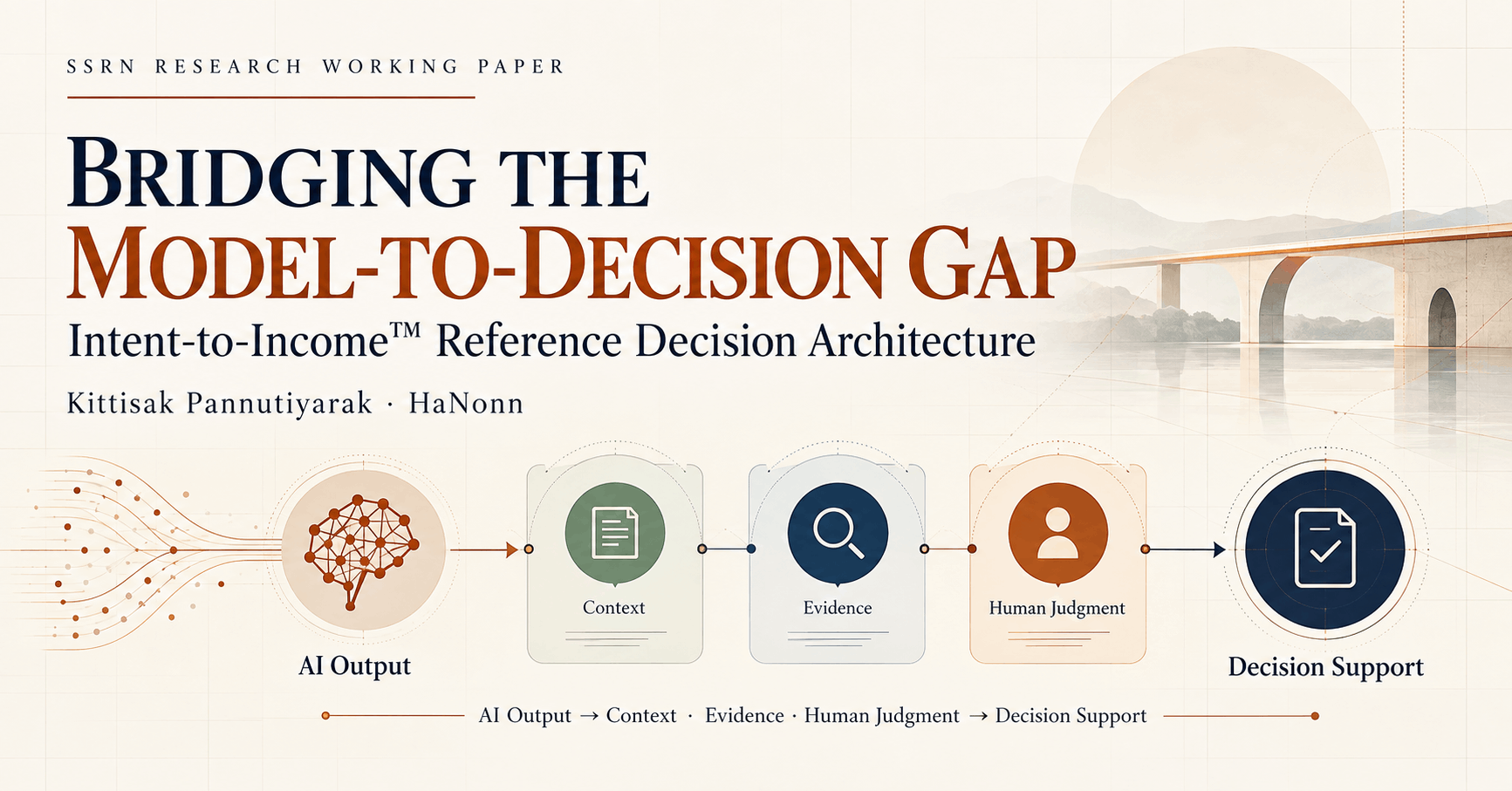
Intent-to-Income™: A Reference Decision Architecture for AI-first Decision Intelligence
TH
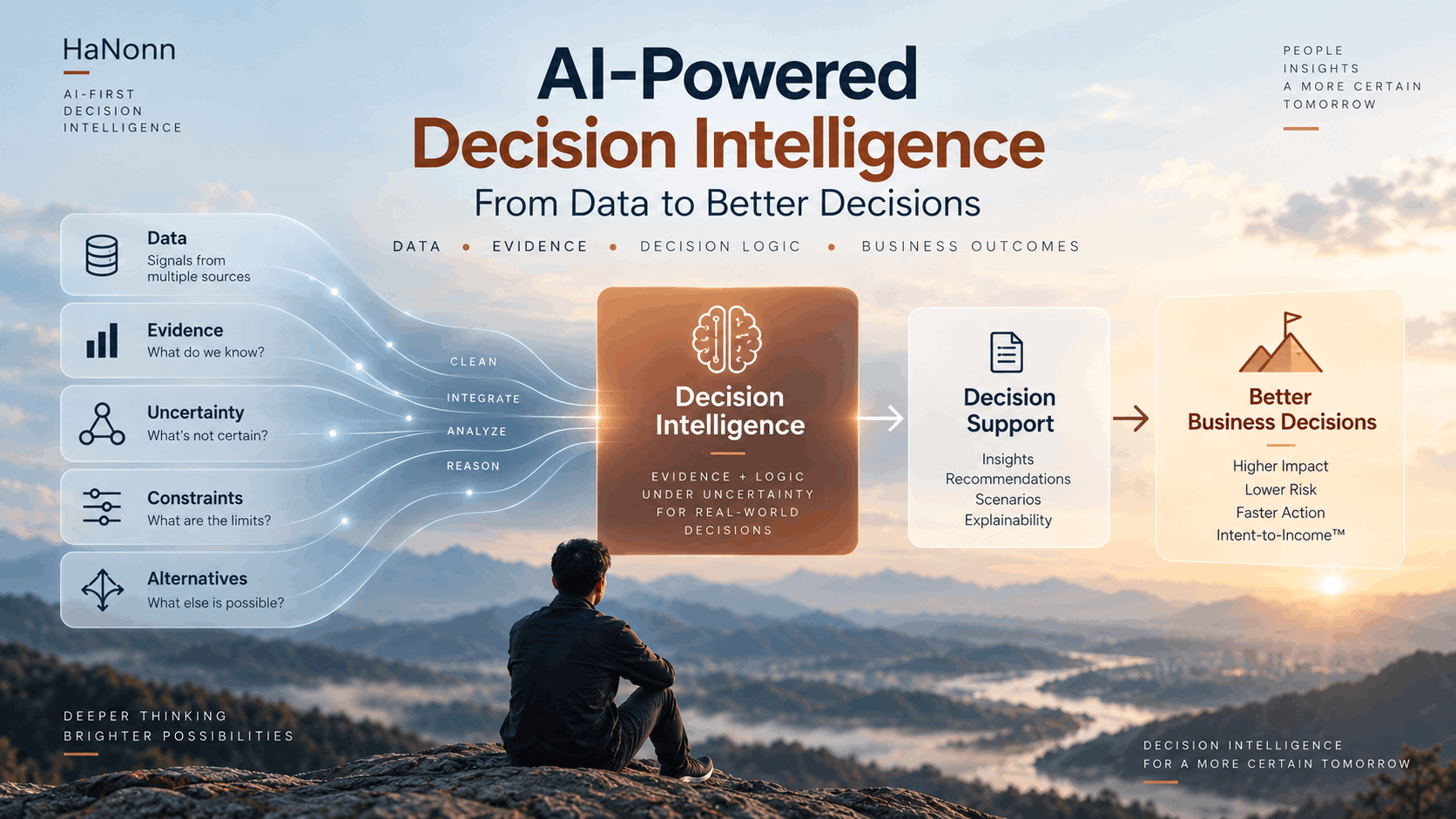
บทความนี้นำเสนอ Intent-to-Income™ ซึ่งเป็น proprietary Reference Decision Architecture ที่พัฒนาโดย HaNonn ภายในบริบทของ AI-first Decision Intelligence สำหรับ Customer Decisions และ Commerce Decisions
Publication Scopeหน้านี้เป็นบทสรุปและข้อมูลอ้างอิงของบทความฉบับเผยแพร่ โดยสามารถเข้าถึงต้นฉบับ รายการอ้างอิง ทั้งหมดได้ผ่าน DOI
Official Abstract
Abstract
AI-mediated search, commerce, and decision-support systems are often evaluated through behavioral or business outcomes such as interaction, engagement, and conversion, which do not necessarily represent the quality of the underlying user decision process.
This paper proposes Intent-to-Income, a proprietary Reference Decision Architecture for AI-first Decision Intelligence focused on Customer Decisions and Commerce Decisions. The architecture defines a canonical core flow—Decision Signals → Decision Need → Decision Support → Decision Quality → Measurable Outcomes—and treats Decision Context as a cross-cutting layer.
It is organized around four core components: Decision Journey Mapping, Decision Signal Matrix, Decision Interface, and Measurement Logic. Decision Quality is explicitly separated from terminal outcomes and is represented through three proposed dimensions: Understanding, Confidence, and Readiness.
These dimensions are conceptual and have not yet been empirically validated. The paper also distinguishes Intent-to-Income from sales funnels, SEO frameworks, conversion-rate optimization frameworks, revenue attribution models, and product recommendation algorithms, while abstracting proprietary implementation details such as internal weighting and evaluation rules.
The contribution is a decision-centered architecture that organizes Decision Signals, Decision Need, Decision Support, Decision Quality, and Measurable Outcomes into a connected structure for AI-mediated Customer and Commerce Decisions. Limitations and directions for empirical validation, measurement development, comparative evaluation, and human oversight are identified.
Keywords:
Decision Intelligence; AI-assisted Decision Support; Human–AI Decision-making; Decision Quality; Customer Decisions; Commerce Decisions; Reference Architecture
Plain-language Summary
สรุปสำหรับผู้อ่านภาษาไทย
งานวิจัยนี้เริ่มจากข้อสังเกตว่า Interaction, Engagement หรือ Conversion สามารถบอกได้ว่าเกิดอะไรขึ้น แต่ยังไม่เพียงพอสำหรับสรุปว่า ผู้ใช้เข้าใจทางเลือก ประเมินหลักฐาน และตัดสินใจได้อย่างเหมาะสมหรือไม่
ผลลัพธ์ที่เกิดขึ้นบอกว่าเกิดอะไรขึ้น แต่ไม่เพียงพอสำหรับยืนยันคุณภาพของการตัดสินใจโดยลำพัง
Research Problem & Gap
ช่องว่างระหว่าง Signals, Decision Support และ Decision Quality
งานด้าน Decision Support Systems, Decision Intelligence, Consumer Decision Support และ Recommender Systems มีรากฐานและงานวิจัยรองรับอยู่แล้ว แต่แนวคิดเหล่านี้มักถูกศึกษาแยกกันตามบริบท ระบบ หรือประเภทของการวัด
ช่องว่างที่ Paper นี้พิจารณาจึงไม่ใช่การไม่มี Decision Support สำหรับผู้บริโภค แต่คือการยังมีข้อจำกัดในการอธิบาย Reference Architecture สำหรับ AI-mediated Customer และ Commerce Decisions ที่เชื่อม Signals, Decision Need, Decision Support, Decision Quality และ Outcomes ไว้ในโครงสร้างเดียวกัน
Research Context & Supporting Literature ↓
- Decision Intelligence:
Moser, Rengarajan and Narayanamurthy examine the fit between intelligence requirements and intelligence-processing capacities.
View source
- DI and Data Science Integration:
Pratt, Bisson and Warin propose an integration framework connecting analytical technologies with strategic decision-making.
View source
- Consumer Decision Support:
Westerman and colleagues examine consumer decision support in internet and in-store settings.
View source
- Decision Quality Measures:
Aksoy, Cooil and Lurie review decision-quality measures used in recommendation-agent research.
View source
Conceptual Contributions
สิ่งที่ Paper เสนอในระดับ Architecture
Contribution ของงานนี้อยู่ที่การจัด Constructs ที่เกี่ยวข้องกับการตัดสินใจให้อยู่ในโครงสร้างเดียวกัน โดยแยกบทบาทและขอบเขตของแต่ละส่วนให้สามารถนำไปศึกษา ออกแบบ และประเมินต่อได้
Contribution ≠ Validation
Contribution ทั้งสี่ข้อเป็นข้อเสนอเชิงสถาปัตยกรรม ไม่ใช่หลักฐานว่าความสัมพันธ์ระหว่าง Layers หรือมิติของ Decision Quality ได้รับการยืนยันเชิงประจักษ์แล้ว
Architecture Model
Architecture at a Glance
Intent-to-Income™ จัด Decision Process เป็น 5 Layers เชื่อมต่อกัน โดยใช้ Decision Context เป็น Cross-cutting Layer และใช้ 4 Core Architecture Components สำหรับทำความเข้าใจ ตีความ ออกแบบ และประเมิน Decision Support

Conceptual Model Boundary
Figure แสดงความสัมพันธ์เชิงสถาปัตยกรรม แต่ไม่ได้ยืนยันความสัมพันธ์เชิงเหตุและผล ประสิทธิผลของ Intervention หรือ Validity ของ Measurement โดยอัตโนมัติ
ดูคำอธิบาย Core Flow, Components และการประยุกต์ใช้เพิ่มเติมที่
Intent-to-Income™ Reference Decision Architecture
Illustrative Application
Knowledge-led Commerce
Paper ใช้คำว่า Knowledge-led Commerce เป็น Domain Label สำหรับ Commerce Decisions ที่ผู้ใช้ต้องพิจารณาข้อมูล ประเมินหลักฐาน เปรียบเทียบทางเลือก และทำความเข้าใจ Trade-offs โดยกรณีสมมติต่อไปนี้แสดงการใช้ Architecture กับ AI Decision Application สำหรับสินค้าที่มีความซับซ้อนทางเทคนิคและ Product Claims ที่ขัดแย้งกัน
Hypothetical Illustration — Not an Evaluation Result
กรณีนี้ใช้แสดงความสัมพันธ์ระหว่าง Layers ภายใน Architecture ไม่ใช่ End-to-end Case, Empirical Evaluation หรือหลักฐานเชิงเหตุและผล และไม่ได้ระบุ Implementation-specific Inference หรือ Measurement Logic ภายในระบบจริง
Measurement & Evaluation
หลักฐานแต่ละระดับตอบคำถามต่างกัน
Measurement Logic แยกหลักฐานที่เกิดระหว่างกระบวนการตัดสินใจ ตัวบ่งชี้ที่อาจเกี่ยวข้องกับ Decision Quality และผลลัพธ์ปลายทางออกจากกัน เพื่อไม่ใช้ Interaction หรือ Business Outcome เป็นตัวแทนของ Decision Quality โดยตรง
การประเมินอาจใช้ Behavioral, Interaction, Assessment และ Evidence-use Signals โดยต้องเลือกให้สอดคล้องกับ Decision Context และข้อกำหนดของ Decision ที่กำลังศึกษา
| Evidence Level | สิ่งที่ช่วยให้เข้าใจ | ตัวอย่าง | สิ่งที่ยังสรุปไม่ได้ |
|---|---|---|---|
| Process Signals | ผู้ใช้ใช้ Decision Support อย่างไร และ Friction เกิดขึ้นตรงไหน | ดูหรือกลับไปตรวจ Evidence, ใช้ Comparison, ย้อนกลับไปดูข้อมูล หรือขอ Clarification | Interaction มากไม่ได้หมายความว่า Decision Quality สูง |
| Decision Quality Signals | Candidate Indicators ที่อาจให้หลักฐานเกี่ยวกับ Understanding, Confidence และ Readiness | Assessment Responses, Evidence-use Patterns, Calibrated Confidence Reports หรือตัวบ่งชี้เฉพาะบริบท | Signal ตัวเดียวไม่สามารถยืนยัน Construct หรือ Decision Quality ได้ |
| Measurable Outcomes | สิ่งที่เกิดขึ้นภายหลังกระบวนการตัดสินใจ | Qualified Next Step, Qualified Lead, Assisted Conversion, Reduced Friction หรือ Better-fit Action | Outcome ไม่ใช่หลักฐานเพียงพอว่า Decision Quality อยู่ในระดับสูง |
Measurement Guardrail
Framework นี้เสนอ Measurement Logic สำหรับการศึกษาในอนาคต ไม่ใช่ Validated Measurement Instrument โดย Construct Validity, Reliability, Operational Definitions และความสัมพันธ์ระหว่างหลักฐานแต่ละระดับยังต้องได้รับการตรวจสอบเชิงประจักษ์
Research Boundaries
Limitations and Validation Status
Intent-to-Income™ เป็น Conceptual Architecture Paper ข้อจำกัดต่อไปนี้จึงกำหนดขอบเขตที่ควรใช้ในการตีความ Contribution และสิ่งที่ยังต้องได้รับการตรวจสอบเพิ่มเติม
01
ยังไม่มี Empirical Validation
02
Proprietary Implementation Logic ถูกทำให้เป็นนามธรรม
03
มีขอบเขตตามวัตถุประสงค์ของ Architecture
04
Generalizability ยังเป็นคำถามสำหรับการวิจัย
Discussion & Future Research
Future Research Agenda
โอกาสในการวิจัยต่ออยู่ที่การตรวจสอบว่า Constructs และความสัมพันธ์ที่ Intent-to-Income™ เสนอ สามารถนิยาม วัด และประเมินได้อย่างน่าเชื่อถือเพียงใดใน Decision Context ที่แตกต่างกัน
| Research Track | คำถามสำคัญ | สิ่งที่ต้องตรวจสอบ |
|---|---|---|
| Decision Quality Validation | Understanding, Confidence และ Readiness สามารถนิยามและวัดเป็นมิติที่แยกจากกันแต่สัมพันธ์กันได้หรือไม่ | Construct Validity, Reliability, Operational Definitions และความสัมพันธ์กับ Satisfaction, Post-decision Regret และ Long-term Decision Utility |
| Measurement Development | จะประเมิน Understanding และ Contextual Confidence โดยไม่พึ่ง Self-report เพียงอย่างเดียว และไม่เพิ่ม Cognitive Burden ได้อย่างไร | การใช้ Behavioral, Interaction, Assessment และ Evidence-use Measures ร่วมกับ Validated Instruments ที่เหมาะสม |
| Human Oversight & Decision Authority | Decision Interface ควรสื่อสาร Uncertainty, Evidence Limitations, Alternatives และ Unresolved Trade-offs อย่างไร | Appropriate Reliance, Over-reliance, Under-reliance และความสามารถของผู้ใช้ในการรับรู้ว่า Evidence ยังไม่เพียงพอ |
| Architecture-level Evaluation | Architecture ให้คุณค่าเพิ่มเติมจาก Conversion-centric หรือ Recommendation-centric Approaches หรือไม่ | Comparative Evaluation ของ Decision Process, Indicator Calibration, Evidence Understanding, Readiness และ Downstream Outcomes |
High-risk Application Boundary
Health Decision Model (HDM) เป็นเพียง Exploratory Application Domain ภายในบริบทของ HaNonn การนำ Architecture ไปใช้กับ Health-related Decisions ต้องมี Independent Validation, Safety Evaluation และ Human Oversight ที่เข้มงวด และไม่ควรถูกตีความเป็นระบบวินิจฉัย รักษา หรือระบบตัดสินใจอัตโนมัติ
ลำดับความสำคัญระยะใกล้คือการกำหนด Operational Definitions และ Evaluation Protocol ก่อนนำ Architecture ไปเปรียบเทียบประสิทธิผลหรือขยายข้อสรุปไปยัง Domain อื่น
Conclusion
Research Significance
ในสภาพแวดล้อมที่ AI มีบทบาทต่อการค้นหา การจัดข้อมูล และการเสนอทางเลือก ระบบที่สนับสนุนการตัดสินใจของมนุษย์ควรถูกแยกออกจากระบบที่ปรับเพื่อ Interaction, Recommendation หรือ Commercial Outcomes เป็นหลัก โดย Intent-to-Income™ แยก Decision Need และ Decision Quality ออกจาก Signals, Support และ Outcomes อย่างชัดเจน
คุณค่าของ Paper ในระยะนี้อยู่ที่ Conceptual Foundation และ Semantic Boundaries ซึ่งสามารถใช้เป็นฐานสำหรับการวิพากษ์ การพัฒนา Measurement และการวิจัยเชิงประจักษ์ โดยยังไม่ได้ยืนยันว่า Architecture หรือ Decision Quality Model ผ่านการตรวจสอบแล้ว
Intent-to-Income™ เสนอฐานสำหรับศึกษาและออกแบบ AI Decision Applications ที่ช่วยให้มนุษย์ประเมิน Evidence, Alternatives และ Next Step ได้อย่างเหมาะสม โดยยังคง Human Decision Authority
Publication Record
How to Cite and Access the Paper
เมื่อต้องการอ้างถึงแนวคิด Contribution หรือ Architecture จากงานวิจัยนี้ ควรอ้างอิง Publication Record บน Zenodo ผ่าน DOI
https://doi.org/10.5281/zenodo.22151798
BibTeX Citation ↓
@misc{pannutiyarak2026intent,
  author    = {Kittisak Pannutiyarak},
  title     = {Intent-to-Income: A Reference Decision Architecture for AI-first Decision Intelligence},
  year      = {2026},
  publisher = {Zenodo},
  version   = {1.0},
  doi       = {10.5281/zenodo.22151798},
  url       = {https://doi.org/10.5281/zenodo.22151798}
}
Citation Note
ใช้ DOI เมื่อต้องการอ้างถึง Paper และใช้ URL ของหน้านี้เมื่อต้องการอ้างถึง Web Summary หรือคำอธิบายประกอบบน HaNonn
Scholarly Sources
References
รายการอ้างอิงต่อไปนี้เป็นแหล่งวิชาการที่ใช้ในต้นฉบับฉบับเผยแพร่
View full reference list ↓
- Aksoy, L., Cooil, B., & Lurie, N. H. (2011). Decision quality measures in recommendation agents research. Journal of Interactive Marketing, 25(2), 110–122.
https://doi.org/10.1016/j.intmar.2011.01.001
- Broder, A. (2002). A taxonomy of web search. ACM SIGIR Forum, 36(2), 3–10.
https://doi.org/10.1145/792550.792552
- Lee, J. D., & See, K. A. (2004). Trust in automation: Designing for appropriate reliance. Human Factors, 46(1), 50–80.
https://doi.org/10.1518/hfes.46.1.50_30392
- Moser, R., Rengarajan, S., & Narayanamurthy, G. (2021). Decision intelligence: Creating a fit between intelligence requirements and intelligence processing capacities. IIM Kozhikode Society & Management Review, 10(2), 160–177.
https://doi.org/10.1177/22779752211017386
- Pirolli, P., & Card, S. K. (1999). Information foraging. Psychological Review, 106(4), 643–675.
https://doi.org/10.1037/0033-295X.106.4.643
- Power, D. J. (2002). Decision support systems: Concepts and resources for managers. Quorum Books.
- Pratt, L., Bisson, C., & Warin, T. (2023). Bringing advanced technology to strategic decision-making: The Decision Intelligence/Data Science (DI/DS) Integration framework. Futures, 152, 103217.
https://doi.org/10.1016/j.futures.2023.103217
- Rahinel, R., Otto, A. S., Grossman, D. M., & Clarkson, J. J. (2021). Exposure to brands makes preferential decisions easier. Journal of Consumer Research, 48(4), 541–561.
https://doi.org/10.1093/jcr/ucab025
- Schemmer, M., Hemmer, P., Kühl, N., Benz, C., & Satzger, G. (2022). Should I follow AI-based advice? Measuring appropriate reliance in human–AI decision-making. CHI Conference on Human Factors in Computing Systems (CHI ’22), Workshop on Trust and Reliance in AI-Human Teams (trAIt).
https://doi.org/10.48550/arXiv.2204.06916
- Simon, H. A. (1977). The new science of management decision (Rev. ed.). Prentice-Hall.
- Westerman, S. J., Tuck, G. C., Booth, S. A., & Khakzar, K. (2007). Consumer decision support systems: Internet versus in-store application. Computers in Human Behavior, 23(6), 2928–2944.
https://doi.org/10.1016/j.chb.2006.06.006