SSRN RESEARCH WORKING PAPER
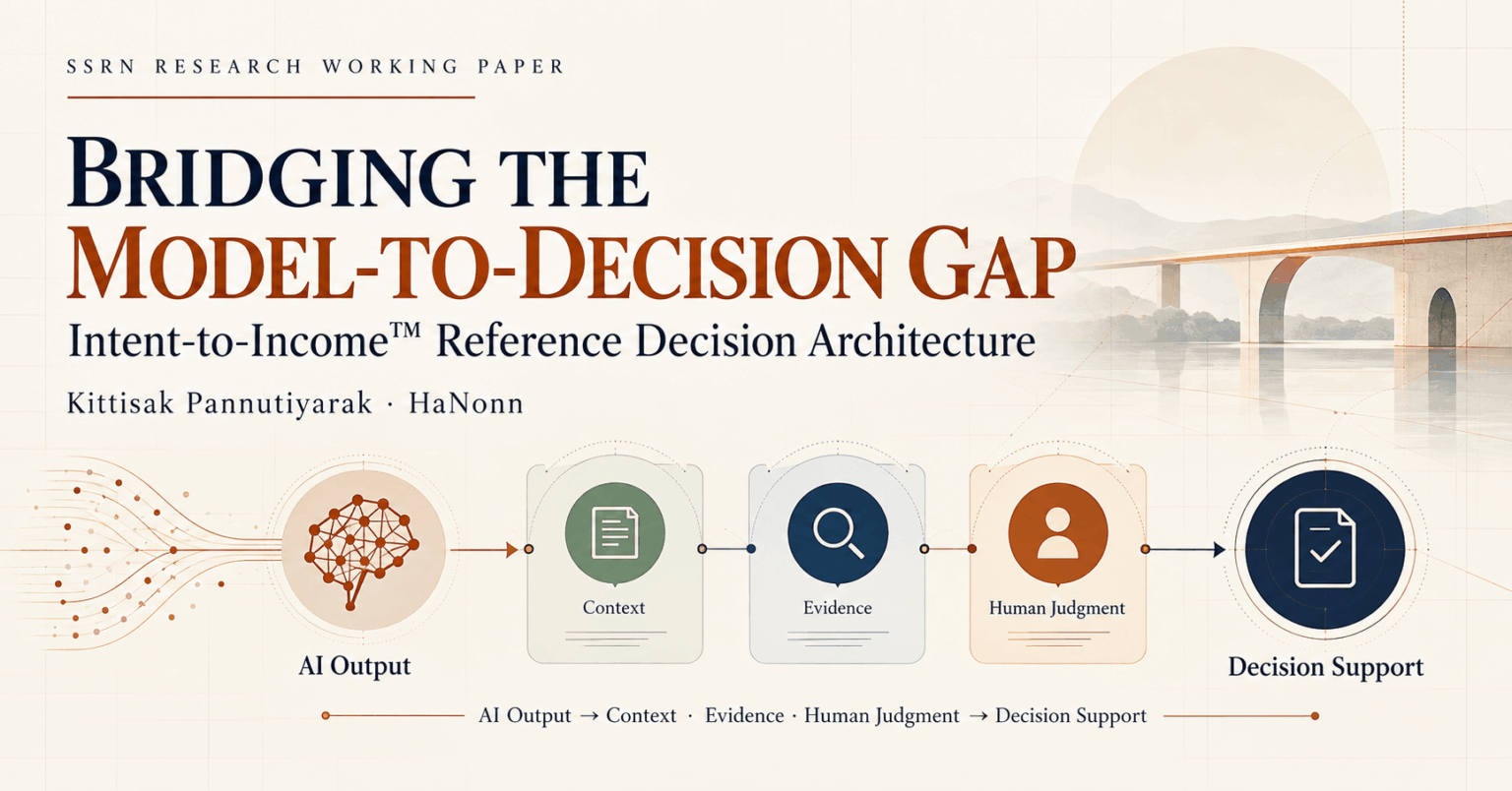
Bridging the Model-to-Decision Gap: Design Rationale and Formative Evaluation of Intent-to-Income™ as a Reference Decision Architecture
AI-generated outputs can inform human decisions, but output alone does not establish that a user’s contextual Decision Need has been addressed, Decision Quality has improved, or downstream outcomes can be attributed to the system.
Building on the previously published Intent-to-Income™ Version 1.0, this paper develops its design rationale, operationalizes the Reference Decision Architecture through an illustrative end-to-end case, and documents specification revisions produced through an internal formative Structured Design Walkthrough.
Author: Kittisak Pannutiyarak
Affiliation: HaNonn
Research: Conceptual synthesis / DSR orientation / Internal formative evaluation
Evidence Boundary ↓
RESEARCH CONTRIBUTION
What This Paper Contributes
The paper makes four connected contributions to the design and evaluation of AI-mediated Decision Support.
THEORETICAL FRAMING
ARCHITECTURAL RATIONALE
FORMATIVE REFINEMENT
EMPIRICAL READINESS
Why This Matters
PROBLEM FRAMING
The Model-to-Decision Gap
The paper uses the Model-to-Decision Gap to describe the design and evaluation problem of connecting AI-mediated outputs and decision-related signals to context-sensitive human Decision Support.
An AI Output may inform a decision, but its existence alone does not establish that the user’s Decision Need was addressed, the support was adequate, Decision Quality improved, or a downstream outcome was caused by the system.
| Analytical Level | Evaluation Question | Evidence Required |
|---|---|---|
| AI Output | What did the model generate? | Accuracy, relevance, provenance, and uncertainty |
| Decision Support | Does the support address the contextual Decision Need? | Context, criteria, evidence, comparison, and next steps |
| Decision Quality | What changed in the person’s decision process or state? | Operational definitions, validated measures, and participant evidence |
| Measurable Outcomes | What action or business outcome followed? | Outcome data, comparison, attribution, and causal design |
How the Term Is Used
Research Object and Questions
The research object is Intent-to-Income™, HaNonn’s previously published proprietary Reference Decision Architecture for AI-first Decision Intelligence, initially focused on Customer Decisions and Commerce Decisions.
This paper examines the architecture’s theoretical rationale, operationalization, formative refinement, and future validation requirements. It does not present the architecture as newly discovered or empirically validated.
Research Question
Five subsidiary research questions ↓
- Framing: What distinctions and design requirements define the Model-to-Decision Gap?
- Rationale: How do the architecture’s stages and components support traceability from signals and context to Decision Support?
- Operationalization: How can a selected decision scenario be represented through traceable, evidence-bounded artifacts?
- Formative evaluation: What findings and specification revisions emerged from the internal Structured Design Walkthrough?
- Validation: What measurement, oversight, implementation, and empirical requirements remain before effectiveness claims?
Prior architecture record:
Intent-to-Income™ Version 1.0
LITERATURE FOUNDATION
Related Work and Theoretical Foundations
The paper draws on established research in Decision Support, human–AI decision-making, information behavior, measurement validity, and Design Science Research.
These foundations inform the requirements used to examine Intent-to-Income™ without treating adjacent concepts or prior research as inventions of the present study.
Five research foundations and their role ↓
Originality Boundary
REFERENCE DECISION ARCHITECTURE
Architectural Rationale
Intent-to-Income™ does not treat AI Output as a completed decision. It preserves the trace from observed signals and contextual interpretation to Decision Support, Decision Quality, and separately assessed outcomes.
Decision Context operates across the architecture by informing how signals are interpreted, needs are proposed, and support is designed.
Decision Context
Four Core Architecture Components ↓
Why the Structure Matters
Explore the full Intent-to-Income™ Reference Decision Architecture ➞
Evidence-Aware AI Decision Support
The paper proposes Evidence-Aware AI Decision Support as an orientation for keeping claims, source provenance, evidence sufficiency, uncertainty, and human-controlled next steps inspectable.
Its purpose is not merely to generate an answer, but to preserve the route from an interpreted Decision Need to the support actually presented.
Evidence Before Recommendation
RESEARCH APPROACH
Research Approach and Evidence Classification
The study combines conceptual synthesis with a Design Science Research orientation, an illustrative applied case, and an internal criteria-based formative evaluation.
Each source and artifact is classified according to the claims it can support, preventing conceptual, illustrative, and formative evidence from being treated as empirical effectiveness evidence.
| Evidence Type | Role in the Study | Permitted Inference |
|---|---|---|
| Research Literature | Establishes prior work, theoretical distinctions, and design requirements. | Supports conceptual framing—not validation of Intent-to-Income™. |
| Architecture Records | Provide canonical definitions, components, boundaries, and the prior Version 1.0 baseline. | Establishes the documented specification—not its effectiveness. |
| Illustrative Case | Uses a synthetic profile, constructed behavioral journey, and identified product-source information. | Demonstrates operationalization—not observed user behavior. |
| Formative Walkthrough | Internally inspects artifact traceability, evidence handling, and design conformance. | Supports design findings and revisions—not independent evaluation. |
| Measurement Plan | Specifies future measures, comparators, governance checks, and validation requirements. | Defines an empirical research agenda—not completed testing. |
Claims Follow Evidence Type
ILLUSTRATIVE CASE · FORMATIVE EVALUATION
Illustrative Case and Formative Evaluation
The study operationalizes selected parts of Intent-to-Income™ through an illustrative Cattus case, followed by an internal Structured Design Walkthrough that records design findings and accepted specification revisions.
Cat Food Decision Support on Cattus
The paper operationalizes selected parts of Intent-to-Income™ through an illustrative cat-food decision scenario on Cattus.
The case combines a synthetic cat-owner profile, a constructed behavioral journey, and identified public product information to produce traceable Decision Support artifacts.
Case ID: CAT-ILL-001
Domain: Commerce Decision Support
Status: Illustrative case, not a user study
From Architecture to Inspectable Artifacts
Explore the full End-to-End Case and Evaluation ➞
Structured Design Walkthrough
The case artifacts were examined through an internal, criteria-based Structured Design Walkthrough to assess architecture conformance, traceability, evidence handling, role separation, and preservation of human Decision Authority.
The evaluation was conducted by the architecture designer. Its recorded statuses concern design conformance—not application effectiveness, participant outcomes, or empirical validation.
Evaluation ID: DE-CAT-001
Method: Internal criteria-based walkthrough
Unit: Design artifacts and specification
Key Accepted Revisions
ROLE SEPARATION
EXPLANATION REQUIREMENT
Additional specification revisions ↓
- Separate Claim, Evidence, Interpretation, and Limitation.
- Preserve Insufficient Evidence as an evidence status—not product failure.
- Use criterion-level comparison without an unvalidated winner score.
- Distinguish product criteria from Decision Interface requirements.
- Allow Next Steps to include verification, revision, selection, or deferral.
- Require reconsideration or escalation in higher-risk contexts.
Inspectable Design Refinement
MEASUREMENT LOGIC
Decision Quality and Measurement Logic
AI Output quality, interface activity, human Decision Quality, and downstream outcomes require different evidence. None should be used automatically as a proxy for another.
Proposed Decision Quality Dimensions
Four future evidence categories ↓
Proposed, Not Yet Validated
EVIDENCE GOVERNANCE
Human Oversight and Application Boundaries
The architecture treats evidence governance and human oversight as design requirements. AI may organize evidence and support evaluation, but final Decision Authority remains with the person.
Architecture and Application roles ↓
Intent-to-Income™ is the Reference Decision Architecture that defines the canonical stages, components, relationships, and boundaries.
HaNonn Decision Composer™ is an AI Decision Application for product-focused evaluation and Decision Support Blueprint generation. It is not the entire architecture, a fifth Core Component, or an autonomous decision maker.
Requirements, Not Compliance Claims
FUTURE VALIDATION
Limitations and Empirical Research Agenda
The current study establishes a theoretical rationale, traceable design artifacts, and a formative revision record. Whether the architecture improves human decisions or business outcomes remains an empirical question.
Current study limitations ↓
- Synthetic profile and constructed behavioral signals
- One illustrative Commerce Decision and a non-exhaustive product set
- Manufacturer information not treated as independent effectiveness evidence
- Internal evaluation conducted by the architecture designer
- No participants, validated measures, comparator, deployment, or business outcomes
- Context recalculation, dry/wet normalization, and higher-risk escalation remain untested
Proposed Empirical Programme
Before Effectiveness Claims
CONCLUSION
From AI Output to an Inspectable Decision Relationship
This paper develops the Model-to-Decision Gap as a bounded framing for distinguishing AI Output, context-sensitive Decision Support, human Decision Quality, and downstream Measurable Outcomes.
It extends the design rationale of the previously published Intent-to-Income™ architecture and shows how an illustrative case and internal formative walkthrough can produce traceable artifacts, design findings, and accepted specification revisions.
Design the Decision Relationship
The result is a literature-informed rationale and an evaluation-ready design specification for future independent review, participant research, comparative evaluation, and cross-context testing.
PUBLICATION RECORD
Paper and Supporting Records
Research Working Paper
Suggested citation ↓
Related Architecture and Case Records ↓
Distinct but Connected Evidence
AUTHOR